The 5GHz MIMO Dish Antenna for Robust Applications
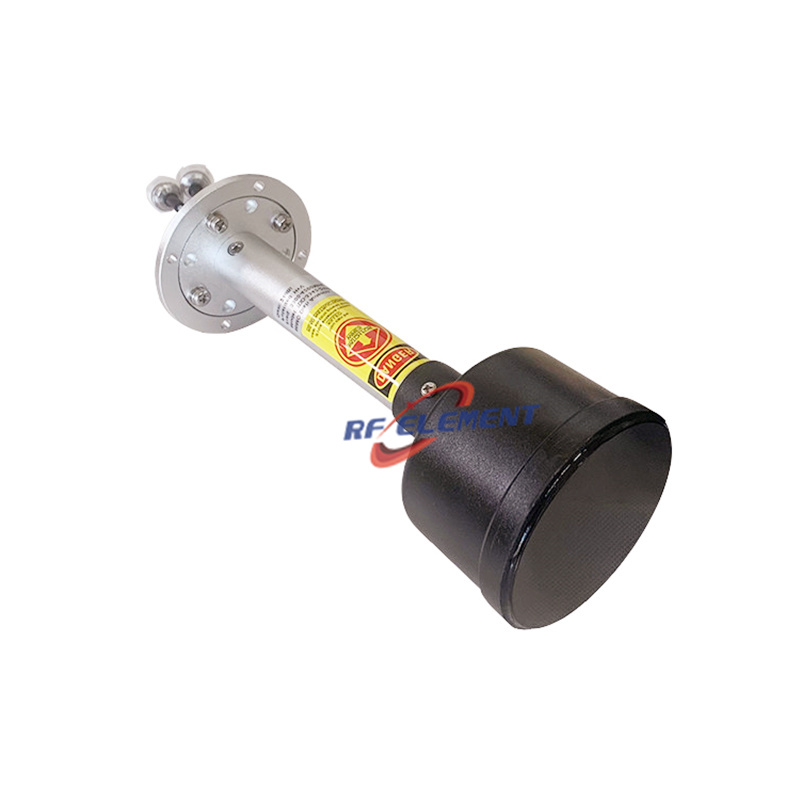
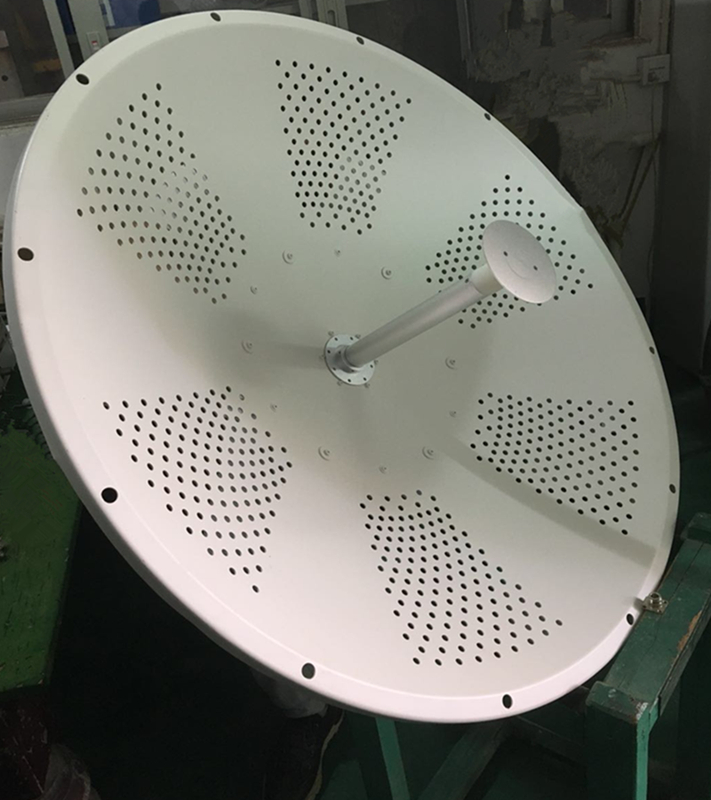
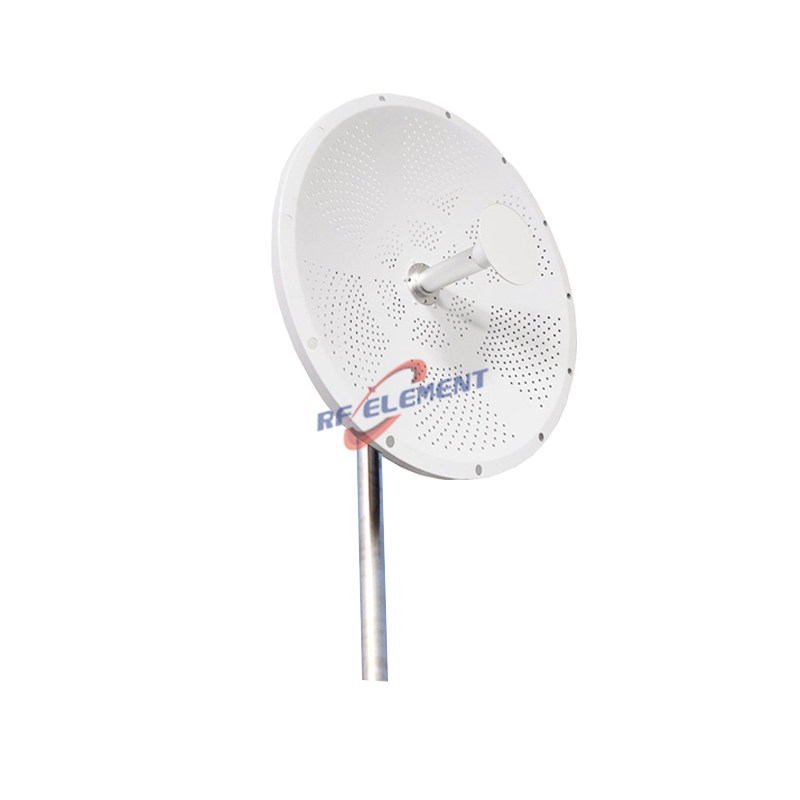
Long-range 5 GHz links live or die on two numbers: how much gain the antenna puts on the signal, and how narrow it keeps the beam. Our 5GHz MIMO parabolic dish family answers both. Two dual-polarized dishes cover 4900-6000 MHz: a 60 cm reflector rated at 30 dBi and a 90 cm reflector rated at 34 dBi, each with two N-type female ports, 100 W power handling, and an operating range of -55° to +60° C. This page sets out the measured numbers behind each dish, explains what dual polarization buys you, and lists the cases where a dish is the wrong tool for the job.
What the reflector does, in numbers
A parabolic reflector concentrates the transmitted power into one narrow lobe. The 60 cm dish delivers 28 dBi across 4900-5150 MHz, 29 dBi across 5150-5850 MHz, and 30 dBi across 5850-6000 MHz, with a half-power beamwidth of 5±0.5°. The 90 cm dish steps this up to 31 dBi, 33 dBi, and 34 dBi across the same three sub-bands, tightening the beamwidth to 4±0.5° and 3±0.5°. Doubling the reflector diameter adds roughly 4 dB — the difference between 30 and 34 dBi is the difference between a link that fades in heavy rain and one that holds margin.
VSWR across the family stays at or below 1.8 on the lowest sub-band, 1.5 mid-band, and 2.0 at the top edge. Cross-polarization discrimination measures 32 dB or better on the lower sub-bands and 30 dB at the top, which is what keeps the two MIMO streams from bleeding into each other. The 60 cm unit weighs 7 kg; the 90 cm unit weighs 12 kg and ships in a 100 × 23 × 100 cm carton.
Why dual polarization matters at 5 GHz
Each dish feeds two independent connectors, one per polarization. Running 2×2 MIMO over a single reflector lets the two streams carry separate data at the same time, so the same aperture and the same tower space deliver up to twice the throughput of a single-polarized dish. For WISP backhaul, campus links between buildings, and fixed wireless access at the edge of a coverage cell, that is capacity gained without buying a second mount.
The polarization ports also help in congested 5 GHz bands: cross-polarization discrimination of 30 dB or better means the horizontal and vertical streams stay separated even when the far end is not perfectly aligned.
Where a 5 GHz dish is the wrong choice
The link runs under a kilometre and the far end needs all-around coverage. A 5GHz MIMO omni antenna with 12 dBi gain covers the site without aiming and without a 7 kg reflector on the pole.
The network still carries 2.4 GHz traffic alongside 5 GHz. Our dual band grid antenna delivers 21 dBi at 2400-2500 MHz and 22 dBi at 5150-5850 MHz in a 600 × 900 mm open grid at 3.2 kg — one antenna, both bands, wind load roughly half of a solid dish.
The job is 5G n78 rather than 5 GHz Wi-Fi. For 3300-3800 MHz point-to-point, our n78 feedhorn rated 23 dBi bolts onto the same 60 cm dishes and 40 × 60 cm grids at 0.8 kg, turning existing hardware into a 3.5 GHz link.
The wider dish family
The same reflector-and-feed approach scales above 5 GHz. Our 7 GHz microwave dish covers 6400-7200 MHz with 32 dBi gain on a 90 cm reflector, VSWR below 1.8, and a dual-polarized feed designed and anechoic-chamber tested in-house. If your frequency plan sits between 4.9 and 7.2 GHz, send it over — one mechanical platform usually covers it with a retuned feed.
For links that need 4 dB more margin than the 60 cm unit, the 34 dBi, 90 cm dual-polarized dish is the drop-in upgrade: same ports, same power rating, same mounting interface, a 3 kg step up in weight.
Choosing between 60 cm and 90 cm
Under 5 km with clear line of sight: the 60 cm, 30 dBi dish usually closes the link with room to spare.
5-15 km, or heavy rain fade on the path: step up to 34 dBi. The extra 4 dB is margin you will use.
Tower space or wind load limited: 7 kg beats 12 kg, and 60 cm catches less wind than 90 cm.
Congested 5 GHz with interference on one polarization: both dishes hold 30 dB+ XPD, so dual-polarized operation is safe on either size.
Future band moves: the reflector stays; swapping the feed is the cheaper upgrade path. Our n78 feedhorn and 7 GHz feed both mount on the same dish sizes we ship today.
Aiming and installation notes
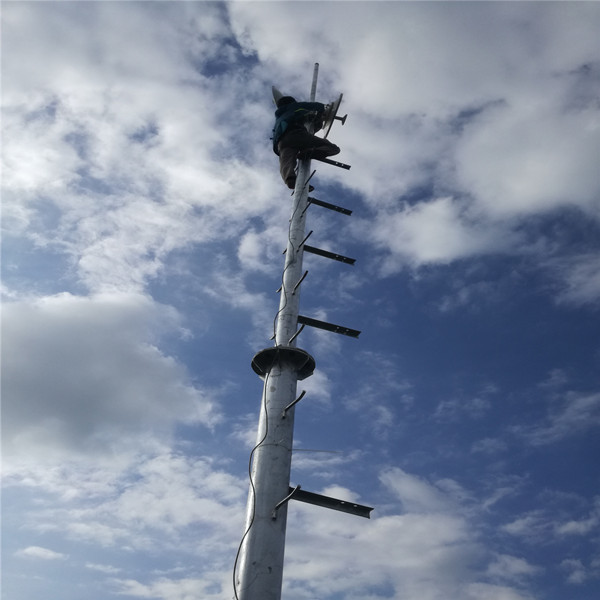
A 5° beamwidth leaves little room for casual alignment — at 10 km, a 5° lobe is roughly 870 m wide, so both ends need to be peaked before you judge the link. Plan for a mount with independent azimuth and elevation adjustment, and expect the alignment pass to take longer than the mechanical install. Two practical checks save rework:
Confirm the pole is plumb in both axes before the dish goes on; a tilted mast costs you elevation range that the bracket cannot recover.
Peak the link on one polarization first, then verify the second port — if port two reads noticeably worse, the far-end rotation is off, not the feed.
The dishes are passively cooled solid reflectors with no electronics inside, so once aimed, the main maintenance item is checking mount torque after the first storm season.
Ordering, samples, and what we send you
Everything above is built and tested at our ZhaoQing facility, and the dishes ship with the full electrical table — per-sub-band gain, beamwidth, VSWR, and port isolation — plus mechanical drawings for the mount. Samples leave our factory in 3-5 working days, and volume orders follow a 15-25 working day schedule; MOQ is low enough to start with a trial link. Write to sales@rfelement.com with your path length, frequency plan, and required throughput, and we will come back with the dish size, a mounting recommendation, plus sample units on request. If you already have dishes on the tower, ask about the feedhorn path — retuning the feed is often cheaper than replacing the reflector.
TAG:The 5GHz MIMO Dish Antenna for Robust Applications https://www.rfelement.com